
Nine Days to 0.001 BTC on One Small Rig
Hobby mining is a different sport from farm mining, and it needs a different scoreboard. A single 250 TH/s machine will not produce a headline number, but it will produce 0.001 BTC every 8.9 days at current difficulty, which is $84.69 at $84,692 per BTC. That is a cadence you can plan around: roughly three small payouts a month, each one large enough to be worth recording.
Key takeaways
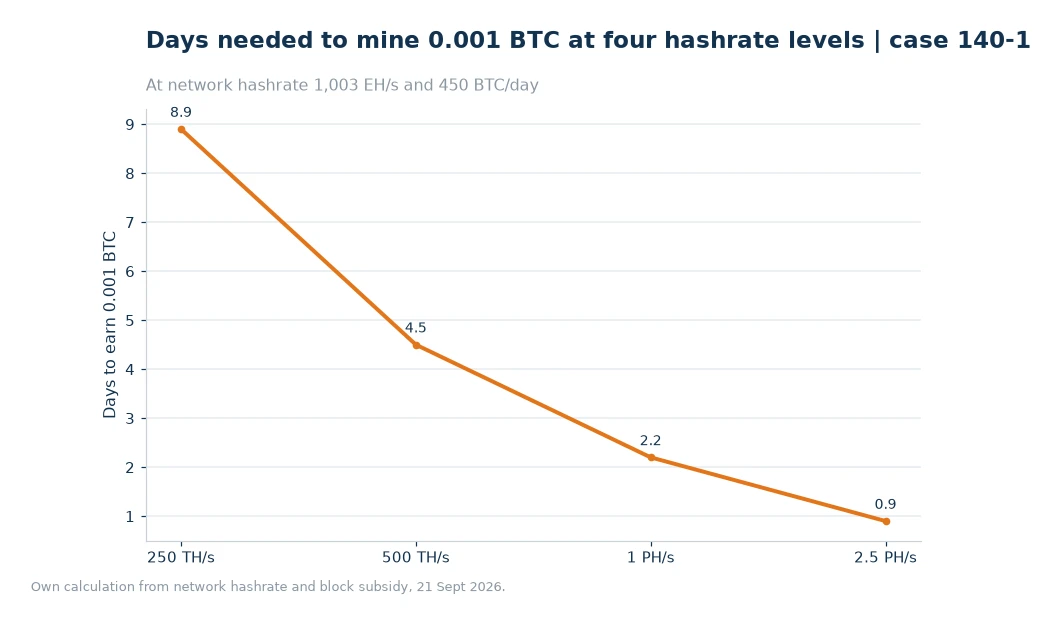
- At 250 TH/s, 0.001 BTC takes 8.9 days; at 500 TH/s, 4.5; at 1 PH/s, 2.2; at 2.5 PH/s, 0.9.
- The daily credit at 250 TH/s is 0.00011215 BTC, about $9.50 at $84,692.
- Small targets make reporting gaps visible faster than large ones, because each step is a larger share of the total.
- Pool Hashrate and Pool Luck explain why the calendar drifts, even when your own rig never changes.
The smallest target worth tracking
Most mining dashboards default to daily earnings in dollars, which is the least useful figure for a hobby setup. Dollars move with a price you do not control, so the same rig looks better or worse week to week without anything changing in the shed. BTC per unit of hashrate is stable by comparison, and a target amount turns that rate into a date.
0.001 BTC is a good first target because it is small enough to arrive within a fortnight on modest hardware and large enough that the arrival is clearly visible in the account history. It also sits comfortably above the noise of rounding in a five-decimal display, which matters when you are reading a balance on a phone.
Why the decimal places matter to a small miner
A 250 TH/s machine credits around 0.00011215 BTC a day. Written out, that is five leading zeros before the first significant digit. At that scale, a display that rounds to four decimals will show a flat zero for a day and then jump, which is why a hobby miner can stare at a correct account and conclude nothing is happening.
The fix is to read the raw figure rather than the rounded one, and to compare cumulative totals at fixed checkpoints. Hourly PPS+ settlement means the account gains a step 24 times a day; over a week that is 168 steps. If you check once a week and only look at the rounded balance, you lose the ability to spot the one day when the steps stopped.
A week at two hundred and fifty terahash
Seven days at 0.00011215 BTC a day is 0.00078505 BTC, or about $66.48 at the read-date price. That is the realistic weekly output of one mid-sized modern rig, before power is subtracted, and it is the number to hold against the electricity bill rather than the annualised figure. Annualising a week of mining assumes a difficulty path nobody can promise. The Profit Calculator will produce the daily figure at current difficulty if you would rather not do the division by hand.
Write the weekly record as three columns: cumulative BTC, the price on the day, and any downtime hours you know about. Two minutes of work produces a series that answers questions a monthly total cannot, such as whether a shortfall came from the price, from difficulty, or from a fan that stopped on Tuesday afternoon. Six months of that record is worth more than a folder of dashboard screenshots.
Weekly comparison also exposes the thing that actually varies at this scale: uptime. A hobby machine shares a domestic circuit with other appliances, sits in a room that gets hot in summer, and gets rebooted when the network drops. Each of those events removes steps. Over a month of perfect running the rig approaches 0.00336 BTC; at 90 percent uptime it lands nearer 0.00303 BTC, and the gap is your own behaviour rather than the pool's.
Where the calendar drifts
Two pool-level readings explain drift. Pool Hashrate is the total speed of every machine on the pool, and your share of each settlement is your hashrate divided by that total: if the pool doubles and you do not, your slice halves. Pool Luck compares blocks found against blocks expected, and while a PPS+ credit does not depend on it, the figure is still the quickest way to see whether a quiet spell is normal variation or something worth asking about.
Neither reading changes what a 250 TH/s machine earns per unit of work. They change how that work converts into a share of a pool, and over months that conversion is what turns an 8.9-day calendar into a 9.5-day one. Watching them is not about predicting; it is about being able to say why the number moved. The ViaBTC BTC Mining Pool page carries both, next to the network difficulty that sets the underlying rate.
| Rig size | BTC per day | Days to 0.001 BTC | Threshold crossings a month |
|---|---|---|---|
| 250 TH/s | 0.00011215 | 8.9 | About 3.4 |
| 500 TH/s | 0.00022430 | 4.5 | About 6.7 |
| 1 PH/s | 0.00044861 | 2.2 | About 13.6 |
| 2.5 PH/s | 0.00112152 | 0.9 | About 33.3 |
The last column is a rough guide, not a schedule: it divides 30 by the calendar and ignores difficulty drift, downtime and the fact that a month is not exactly 30 days. It is still useful for choosing a target. If three payouts a month feels like the right reporting rhythm, 250 TH/s is the natural size; if daily is the preference, the table says you need roughly 2.5 PH/s.
Worked example
Rebuild the 250 TH/s row from the network inputs.
- Per TH/s per day: 450 ÷ 1,003,000,000 = 0.00000044865 BTC.
- At 250 TH/s: 250 × 0.00000044865 = 0.00011216, rounded to 0.00011215 BTC a day.
- Days for 0.001 BTC: 0.001 ÷ 0.00011215 = 8.916, which the chart rounds to 8.9.
- Weekly total: 7 × 0.00011215 = 0.00078505 BTC.
- Weekly value: 0.00078505 × 84,692 = $66.48.
- Monthly total if nothing stops: 30 × 0.00011215 = 0.0033645 BTC, or about $284.95.
- Subtract the listed 4% on the block-reward component: 0.0033645 × 0.04 = 0.00013458, leaving 0.00322992 BTC in the best case.
Read the last two lines together with the electricity bill. At a typical domestic rate the power cost for a single modern rig can approach the monthly credit, which is why hobby mining is usually judged as a way to accumulate coin rather than as a way to reduce a bill.
Frequently asked questions
How long does 0.001 BTC take on one machine?
At 250 TH/s it takes 8.9 days at the 21 Sept 2026 network rate; a 500 TH/s machine halves that to 4.5 days, and 1 PH/s brings it to 2.2 days.
Is a small balance safe to leave in the pool account?
It is a normal working balance, and mining payouts are zero-fee when you move it. Decide a threshold such as 0.001 BTC and withdraw when it is crossed.
Does Pool Luck affect my hourly credit?
Under PPS+ the block-reward component is paid against current difficulty, so Pool Luck does not change it. It is a diagnostic for block discovery, useful for context rather than for predicting a payout.
Make the target the habit
Pick the amount, not the date. "0.001 BTC by the end of the month" survives a difficulty change; "0.001 BTC by the fourteenth" does not, and missing it teaches you nothing. Check the account weekly, record the cumulative figure and the price on the same line, and let the calendar stretch or shrink without drama.
The ViaBTC App is well suited to this rhythm because it puts the hashrate series and an alert on the same screen you already carry. Set the alert just below your normal daily expectation, high enough that a rebooted rig trips it and low enough that a slow afternoon does not. Then the only thing left to do is run the machine and let 8.9 days become a fortnight, a month and finally a balance worth moving.
Sources: ViaBTC pool state, the app listing and the fee schedule, for settlement timing and the listed 4%[1]. Snapshot taken 21 Sept 2026: 132.76 T difficulty, network hashrate near 1,003 EH/s, subsidy of 3.125 BTC, 144 blocks a day, BTC $84,692. Published 24 Oct 2026; figures read 21 Sept 2026, uptime assumed continuous.